
Free format8 min read
Schedule H1 register format
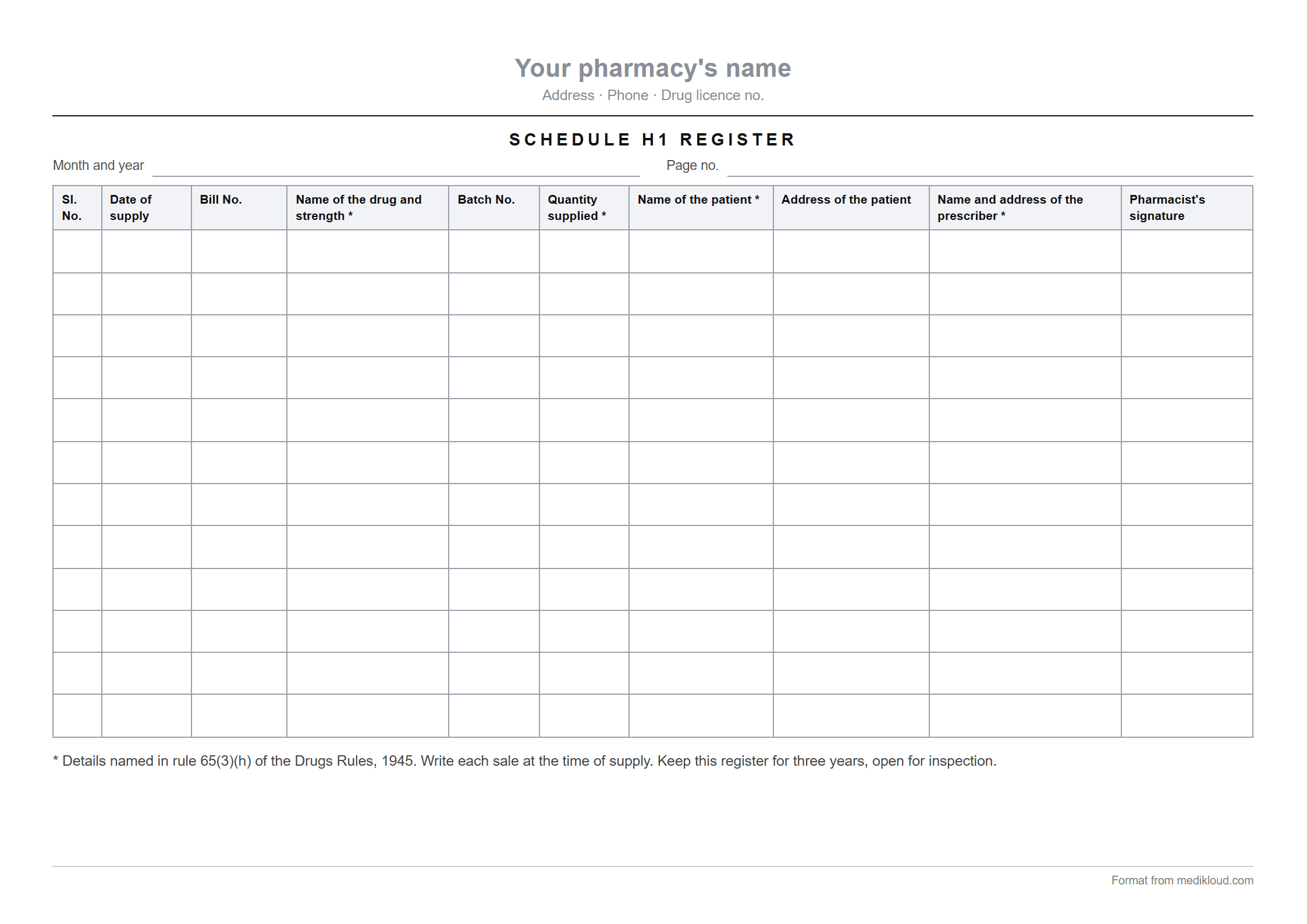
Every sale of a Schedule H1 drug goes into a separate register at the time of sale. Write the prescriber's name and address, the patient's name, the drug and the quantity. Keep it for three years. This free register prints on A4, with 12 sales a page.

Free Schedule H1 register
- One A4 page on its side, with 12 rows
- The four details the rule names are starred
- Add your pharmacy's name and licence number in Word
Free · no sign-up
The rule
Who has to keep a Schedule H1 register
Every pharmacy or medical store that sells a Schedule H1 drug by retail keeps a separate register of those sales. Rule 65(3)(h) of the Drugs Rules, 1945 says so. It was put in by G.S.R. 588(E) of 30 August 2013.
- When to write
- At the time of the supply, while the patient is at the counter.
- What to write
- The prescriber's name and address, the patient's name, the name of the drug and the quantity supplied.
- How long to keep it
- Three years.
- Who can see it
- It must be open for inspection. Rule 65(6) says you produce your registers when a drugs inspector asks.
The rule says a separate register, so keep these sales apart from your prescription register and cash memos.
We made this register for the staff who sell at the counter. It comes from MediKloud, pharmacy management software for medical stores and chemists in India.
This page is not legal advice. It quotes the rule as published. Your state drugs control department can tell you what its inspectors expect.
The format, column by column
Schedule H1 register format: what goes in each column
The register has ten columns. Four of them, starred on the paper, hold the details rule 65(3)(h) names. Five come from the same sub-rule's list for the prescription register. The bill number helps you find the sale again.
| Column | Which rule asks | What to write |
|---|---|---|
| Sl. No. | Rule 65(3)(a), prescription register | A running number down the page, so a torn-out row shows. |
| Date of supply | Rule 65(3)(b), prescription register | The day the drug left the counter, not the day the bill was settled. |
| Bill No. | For tracing | The number on the bill you gave the patient, so the sale can be found again. |
| Name of the drug and strength * | Rule 65(3)(h) | The name as on the strip, with the strength. |
| Batch No. | Rule 65(3)(f), prescription register | From the strip you sold, so a recall can be matched. |
| Quantity supplied * | Rule 65(3)(h) | The number of tablets, capsules or vials. |
| Name of the patient * | Rule 65(3)(h) | As written on the prescription. |
| Address of the patient | Rule 65(3)(d), prescription register | As the prescription gives it, or as the patient tells you. |
| Name and address of the prescriber * | Rule 65(3)(h) | Copy both from the prescription. A doctor's name alone is not enough. |
| Pharmacist's signature | Rule 65(3)(g), prescription register | The registered pharmacist who supplied the drug, or supervised the supply, signs each row. |
The prescription register list also asks for the manufacturer and the expiry date of Schedule H and H1 drugs, in rule 65(3)(f). Keep those in your prescription register or on your cash memos. This register sits beside them.
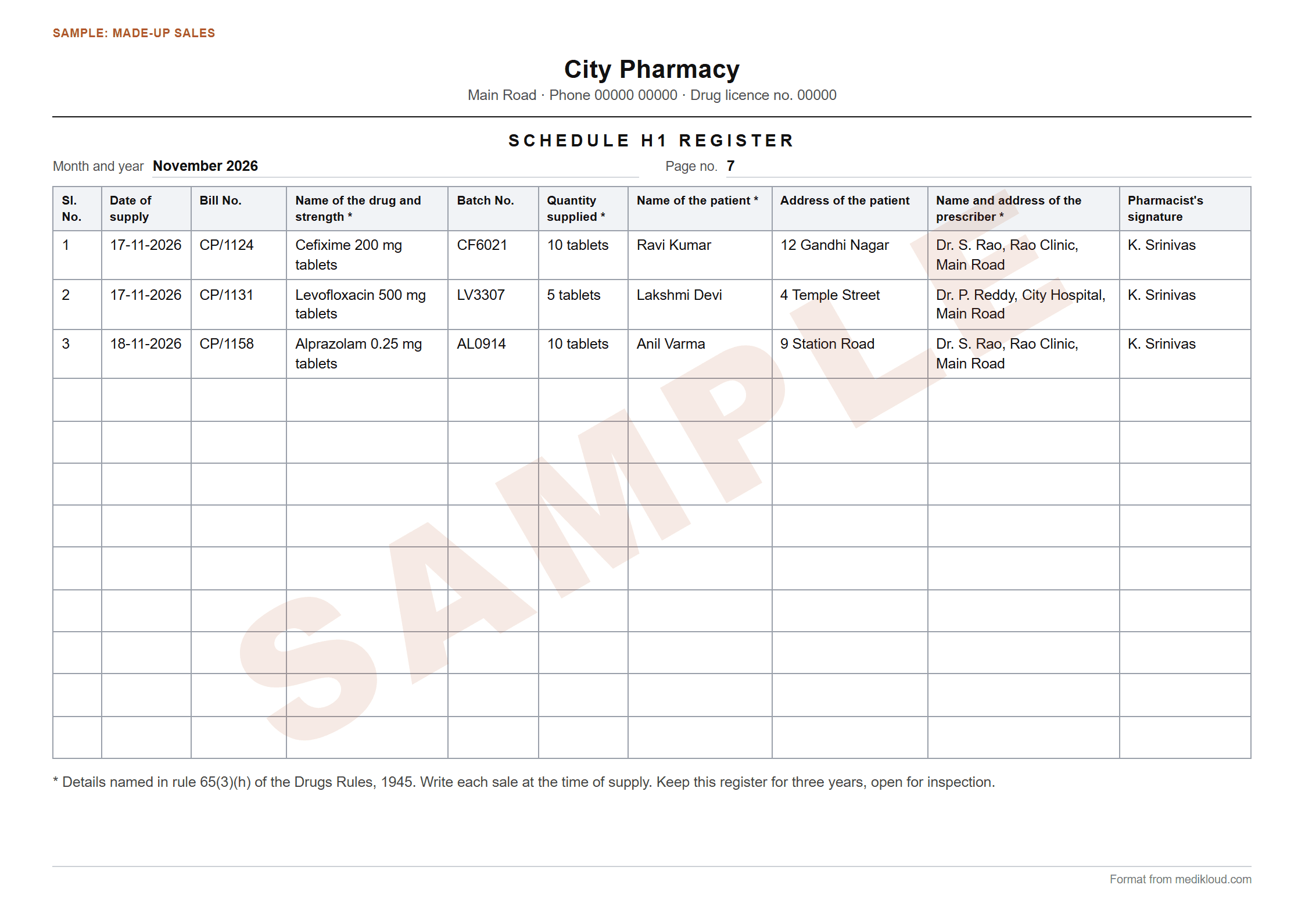
Here is one page filled in with three made-up sales.
| Sl. No. | Date of supply | Bill No. | Name of the drug and strength | Batch No. | Quantity supplied | Name of the patient | Address of the patient | Name and address of the prescriber | Pharmacist's signature |
|---|---|---|---|---|---|---|---|---|---|
| 1 | 17-11-2026 | CP/1124 | Cefixime 200 mg tablets | CF6021 | 10 tablets | Ravi Kumar | 12 Gandhi Nagar | Dr. S. Rao, Rao Clinic, Main Road | K. Srinivas |
| 2 | 17-11-2026 | CP/1131 | Levofloxacin 500 mg tablets | LV3307 | 5 tablets | Lakshmi Devi | 4 Temple Street | Dr. P. Reddy, City Hospital, Main Road | K. Srinivas |
| 3 | 18-11-2026 | CP/1158 | Alprazolam 0.25 mg tablets | AL0914 | 10 tablets | Anil Varma | 9 Station Road | Dr. S. Rao, Rao Clinic, Main Road | K. Srinivas |
At the counter
How to fill the H1 register at the time of sale
The rule says "at the time of the supply". So write the register while the patient is at the counter, not in the evening from a pile of bills.
- Check the prescription.Rule 65(9)(a) says Schedule H and H1 drugs are sold by retail only on the prescription of a registered medical practitioner. No prescription, no sale.
- Write the row before you hand over the strip.The prescription is in your hand, and the doctor's address is on it.
- Ask if the address is missing.If the prescription has no prescriber address, ask the patient which clinic or hospital it came from, and write that in.
- Mark the prescription.Write your pharmacy's name and address and the date on it, above the doctor's signature. Rule 65(11) asks for this. It also says a prescription is not dispensed more than once, unless the doctor has written that it may be.
- Sign the row.The registered pharmacist who supplied the drug, or supervised the supply, signs it.
- Start a new page each month, and fill in the month, the year and the page number at the top.
- If a row goes wrong, strike it through once and write the correct row below. Do not overwrite.
- Keep the register at the counter, open at the current page.
On the shelf
How to tell a drug is Schedule H1
Look at the strip or the carton. Rule 97(1)(e) of the Drugs Rules, 1945 asks for a red Rx on the top left of an H1 drug's label, and a box with a red border with the words "Schedule H1 Drug - Warning". The box also says it is dangerous to take the medicine except on medical advice, and that it is not to be sold by retail without a doctor's prescription.
Schedule H drugs carry an Rx and a warning too, so read the words of the warning. If they say Schedule H1, the sale goes in this register. Some H1 drugs that also fall under the NDPS Act, such as Tramadol, carry NRx on the label.
Schedule H1 itself lists the drugs by name. Alprazolam, Cefixime, Levofloxacin, Tramadol and Zolpidem are among them. The list changes by notification in the Gazette of India:
- Pregabalin and its formulations, entry 51, added by G.S.R. 377(E). In force since mid-November 2026, 180 days after the Gazette of 20 May 2026.
- Oral medicines with more than 12% alcohol, in packs or bottles of more than 30 ml, entry 52, added by G.S.R. 607(E). In force from January 2027, six months after the Gazette of 9 July 2026.
When a new drug reaches your shelf, check its schedule on the label and on the latest notification on the CDSCO website.
Inspection
Keeping the register ready for the drugs inspector
An inspector can hold your register against your bill book. An H1 sale in the bill book that is missing from the register will show.
- Your pharmacy's name, address and drug licence number on every page
- Pages numbered, and three years of them kept together, in order
- The current month at the counter, older months in one file in the office
- Once a month, five H1 bills picked at random, each found in the register
The same register, from your bills
The H1 register in MediKloud pharmacy software
In MediKloud, each medicine carries its schedule. The staff member picks the doctor at the counter while billing. When the bill is made, the sale goes into the drug register by itself. This covers Schedules G, H, H1, X, C, C1, K and E1, and NDPS drugs.
- The drug's schedule is printed on the bill.
- The register downloads as Excel.
The Excel register does not carry the doctor's address, which rule 65(3)(h) asks for. So keep the paper register, or add the address by hand, until your state drugs control department says a printout is enough.
Software does not change the rule. The pharmacist still checks every prescription before the sale.
Questions about the Schedule H1 register
- What is a Schedule H1 register?
It is a separate register of every sale of a Schedule H1 drug. Rule 65(3)(h) of the Drugs Rules, 1945 asks for it. It records the prescriber's name and address, the patient's name, the drug and the quantity, at the time of sale. The pharmacy keeps it for three years.
- What is the difference between Schedule H and Schedule H1?
Both are sold only on a prescription from a registered medical practitioner. Only Schedule H1 sales go in a separate register. H1 labels also carry a red Rx and the red-bordered "Schedule H1 Drug - Warning" box.
- How long must a pharmacy keep the H1 register?
Three years, and it must be open for inspection. Keep the pages together and in order, with your pharmacy's name and drug licence number on each.
- Is there a Schedule H1 register format in PDF?
Yes. This page has the register as a PDF to print and as a Word file to edit. Both are free, with no sign-up. Print as many pages as you need and have them bound as one register book.
- Can a medical store keep the H1 register on a computer?
The rule asks for a separate register. It does not say whether it is on paper or on a computer. Ask your state drugs control department what its inspectors accept.
- Is the narcotic register the same as the H1 register?
No. Drugs under the NDPS Act have their own records under the NDPS Rules, 1985. Some H1 drugs that also fall under the NDPS Act, such as Tramadol, carry NRx on the label. Ask your drugs inspector which records your shop must keep for it.