
Free format9 min read
Discharge summary format
A free format for hospitals in India, with a filled-in sample. Add your hospital's name and logo in Word, or print the PDF and fill it by hand.

Free discharge summary format
- Word, to add your hospital's name and logo
- PDF, to print and fill by hand
- Three A4 pages, then the same pages filled in for a sample patient
Free · no sign-up
MediKloud is hospital management software for private hospitals and nursing homes in India. In MediKloud, AI writes a draft of the discharge summary from the patient's records, and the doctor checks and signs it. See how it works.
To fill it in on screen instead, use the free discharge summary maker at the end of this page. It lays your text out on an A4 page to print or save as a PDF, and nothing you type leaves your browser.
The format
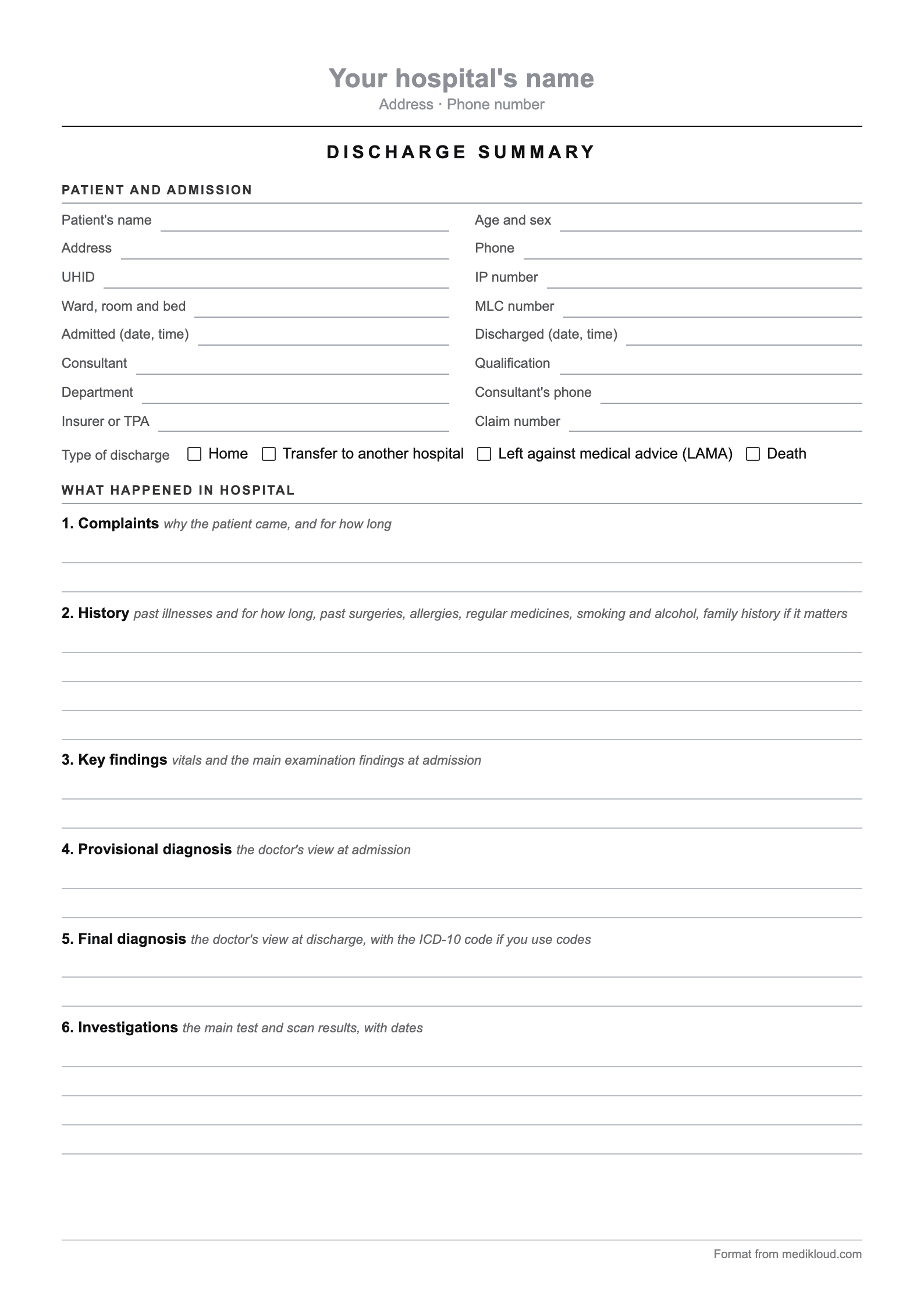
Discharge summary template (blank)
The sections hospitals in India use, in the usual order. Write "Nil" where a section does not apply.
Patient and admission
At the top: your hospital's name, address and phone number, then the title, Discharge summary.
- Patient's name, age, sex, address and phone number
- UHID (the hospital's patient ID number) and IP number (the admission number)
- Ward, room and bed
- Date and time of admission, and of discharge
- MLC (medico-legal case) number, if any
- Consultant: name, qualification, department and phone number
- Type of discharge: home, transfer to another hospital, left against medical advice (LAMA), or death
- Insurance, if any: the insurer or TPA, and the claim number
What happened in hospital
| Section | What to write |
|---|---|
| 1Complaints | why the patient came, and for how long |
| 2History | past illnesses and for how long, past surgeries, allergies, regular medicines, smoking and alcohol, family history if it matters |
| 3Key findings | vitals and the main examination findings at admission |
| 4Provisional diagnosis | the doctor's view at admission |
| 5Final diagnosis | the doctor's view at discharge, with the ICD-10 code if you use codes |
| 6Investigations | the main test and scan results, with dates |
| 7Consultations | other specialists who saw the patient, and their advice |
| 8Procedures | each procedure or surgery, with the date, the type of anaesthesia and any implant used |
| 9Operative findings | what the surgeon found |
| 10Treatment given | the main medicines and fluids given in the ward |
| 11Hospital course | how the patient did during the stay, and any complications |
| 12Condition at discharge | vitals, and how the patient is on the day they leave |
The format
Going home, and the signatures
The part the patient takes home: the medicines, the advice and the review visit.
| Section | What to write |
|---|---|
| 13Discharge medicines | a table with the medicine, dose, route, how often, how many days, and when to take it. Write how often as three numbers for morning, afternoon and night: 1-0-1 means one in the morning and one at night. List the regular medicines to continue, and name any to stop. |
| 14Advice | diet, activity and wound care, and the signs that mean "come back at once" |
| 15Tests required | tests to do after discharge, and when |
| 16Follow-up | the date and the doctor for the review visit |
| 17Emergency contact | the hospital's phone number |
| 18Others | anything else the next doctor should know |
Signatures
| Who signs | What they add |
|---|---|
| Prepared by | the duty doctor's name and signature |
| Consultant | name, qualification, registration number, signature and date |
| Patient or attendant | "I have received this summary and understood the advice", with name and signature |
Sample
Discharge summary sample
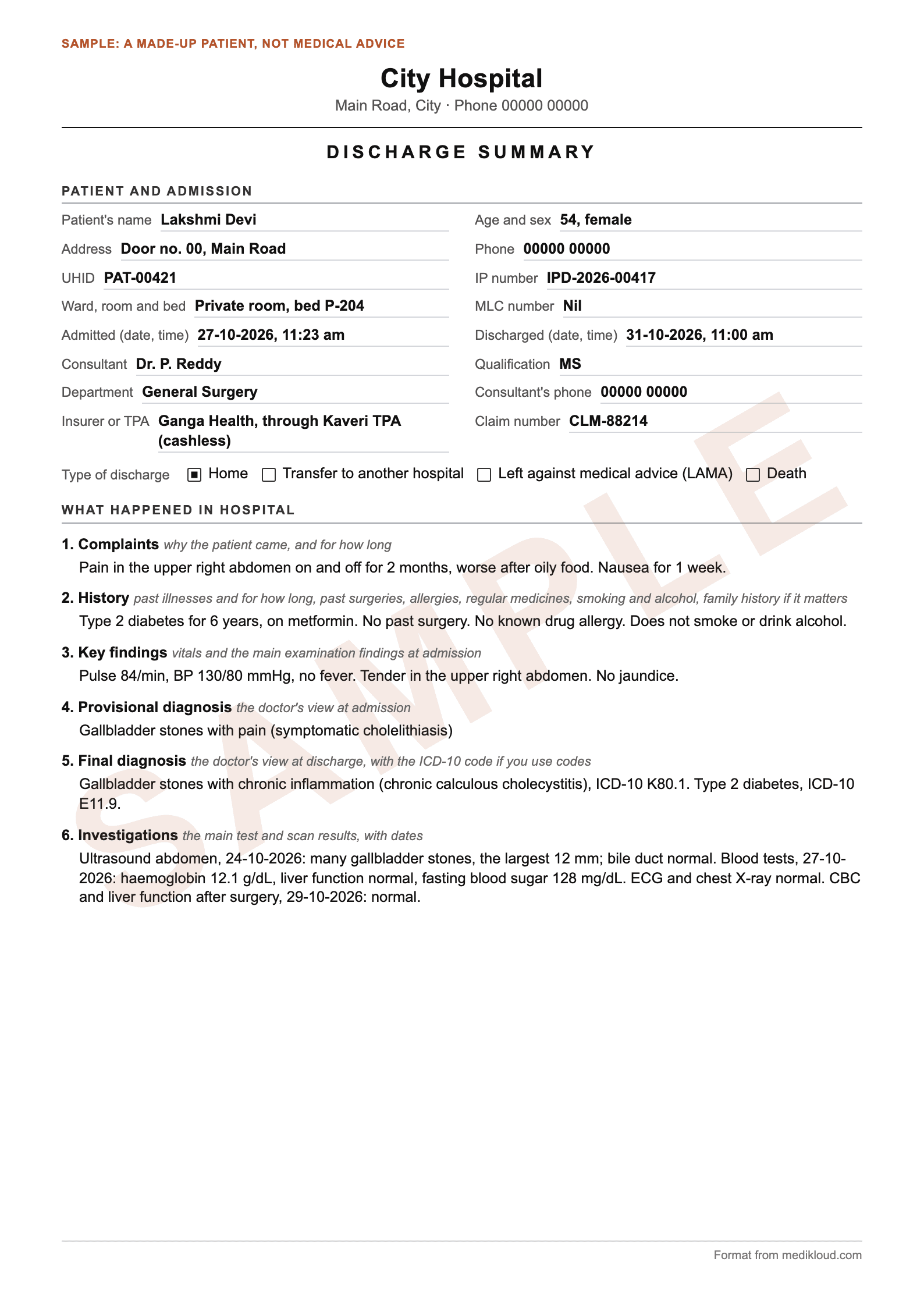
The same format, filled in for a made-up patient after planned gallbladder surgery. It is not medical advice.
- Patient
- Lakshmi Devi, 54, female
- Address and phone
- Door no. 00, Main Road. Phone 00000 00000
- UHID and IP number
- PAT-00421 and IPD-2026-00417
- Ward, room and bed
- Private room, bed P-204
- Admitted
- 27-10-2026, 11:23 am
- Discharged
- 31-10-2026, 11:00 am
- MLC number
- Nil
- Consultant
- Dr. P. Reddy, MS, General Surgery. Phone 00000 00000
- Type of discharge
- Home
- Insurance
- Cashless: Ganga Health, through Kaveri TPA. Claim number CLM-88214
- Complaints
- Pain in the upper right abdomen on and off for 2 months, worse after oily food. Nausea for 1 week.
- History
- Type 2 diabetes for 6 years, on metformin. No past surgery. No known drug allergy. Does not smoke or drink alcohol.
- Key findings
- Pulse 84/min, BP 130/80 mmHg, no fever. Tender in the upper right abdomen. No jaundice.
- Provisional diagnosis
- Gallbladder stones with pain (symptomatic cholelithiasis)
- Final diagnosis
- Gallbladder stones with chronic inflammation (chronic calculous cholecystitis), ICD-10 K80.1. Type 2 diabetes, ICD-10 E11.9.
- Investigations
- Ultrasound abdomen, 24-10-2026: many gallbladder stones, the largest 12 mm; bile duct normal. Blood tests, 27-10-2026: haemoglobin 12.1 g/dL, liver function normal, fasting blood sugar 128 mg/dL. ECG and chest X-ray normal. CBC and liver function after surgery, 29-10-2026: normal.
- Consultations
- Anaesthetist, 27-10-2026: fit for surgery under general anaesthesia. Physician, 27-10-2026: blood sugar control around surgery.
- Procedures
- Laparoscopic cholecystectomy (keyhole removal of the gallbladder) under general anaesthesia, 28-10-2026. No implant.
- Operative findings
- Thick-walled gallbladder with many stones. No pus or bile leak. Gallbladder sent for histopathology (HPE).
- Treatment given
- IV fluids, injection ceftriaxone, injection paracetamol for pain, injection pantoprazole, and insulin as per blood sugar
- Hospital course
- Surgery went as planned. Liquids the same evening and a normal diet the next day. Walking from the first day after surgery. Blood sugar under control.
- Condition at discharge
- Stable. Pulse 78/min, BP 126/80 mmHg, no fever. Eating and walking normally. Wounds clean and dry.
Discharge medicines
| Medicine | Dose | Route | How often | Days | When to take it |
|---|---|---|---|---|---|
| Paracetamol 650 mg tablet | 1 tablet | By mouth | 1-1-1 | 5 | After food |
| Pantoprazole 40 mg tablet | 1 tablet | By mouth | 1-0-0 | 7 | Before breakfast |
| Metformin 500 mg tablet | 1 tablet | By mouth | 1-0-1 | Continue | After food, as before admission |
- Advice
- Normal diet, with less oily food for 2 weeks. Walk every day. No heavy lifting for 4 weeks. Keep the wounds dry for 2 days. Check blood sugar at home.
- Come back at once if
- Fever, pain that gets worse, vomiting, yellow eyes or urine, or pus from a wound
- Tests required
- Fasting blood sugar before the review visit. HPE report of the gallbladder: collect it at the review.
- Follow-up
- Dr. P. Reddy, surgery OPD, 07-11-2026, for a wound check and the HPE report
- Emergency contact
- City Hospital, 24 hours: 00000 00000
- Others
- Nil
- Prepared by
- Duty doctor (signed), 31-10-2026
- Signed by
- Dr. P. Reddy, MS (General Surgery), registration number 00000, 31-10-2026
- Received by
- Lakshmi Devi (patient): I have received this summary and understood the advice.
AI discharge summary
Discharge summary software: drafted from the patient's records
Most of a discharge summary was already written once, during the stay. On paper, someone copies it out of the case file. In MediKloud, AI writes a draft from those same records.
| Section | Where it comes from in MediKloud |
|---|---|
| Complaints, history and allergies | The admission assessment by the nurse and doctor |
| Diagnosis at admission and at discharge | What the doctor recorded in the patient's file |
| Investigations | Lab and imaging tests done during the stay |
| Consultations | Other doctors who were asked to see the patient |
| Procedures and operative findings | Procedure orders and the OT record |
| Treatment given and hospital course | Ward rounds, orders and the doses given |
| Discharge medicines | The ward medicines still being given. The doctor changes them for home. |
| Tests required | Tests ordered and still pending |
The doctor's part
- Start the draftOn the patient's discharge screen, start the AI draft.
- AI writes itFrom the records of the stay.
- The doctor signsRead it, make changes and sign it.
- Notes kept only on paper are not in the draft, so the doctor adds them
- Each doctor picks the sections their summaries must have
- A follow-up date creates a follow-up task for your front desk, and the patient gets a WhatsApp reminder the day before the review visit
More: hospital management software and IPD and bed management software.
Discharge checks
Is anything left pending at discharge?
Before a patient is discharged, MediKloud checks the bill, the lab and the pharmacy.
- Bill. Settled, with nothing left to pay.
- Lab. No sample still waiting to be collected.
- Pharmacy. No medicine order still waiting.
A check may not be clear, such as a cashless bill still waiting for the insurer. Staff can still go ahead, but they must type a reason, and MediKloud records it with their name. More: hospital billing software and insurance and TPA claims.
Questions about discharge summaries
- What is a discharge summary?
A discharge summary is the doctor's written record of a patient's hospital stay, given when the patient goes home. It says why they were admitted, what was found and done, the medicines for home, and when to come back. The next doctor and the insurer or TPA also rely on it. Some hospitals call it a discharge card or an IPD discharge summary.
- What is the standard format for a hospital discharge summary?
Each hospital uses its own layout, but the parts are much the same: patient and stay details, what was found and done, the condition at discharge, the plan for home, and the doctor's signature. The format on this page has all of them, in Word and PDF.
- How do you write a discharge summary?
Fill each section from the patient's file: the admission notes, round notes, test reports, OT notes and drug chart. Keep each section short, with dates. The doctor then checks it, signs it and dates it.
- What makes a good discharge summary?
The next doctor can see the main findings, the treatment and the medicines to continue. The patient can follow the medicines and advice at home. Every date is filled in. Each long-term illness says how long the patient has had it, such as diabetes for 6 years.
- Is there a discharge summary format for pregnancy and childbirth?
Use the same format and add the birth details. Write the weeks of pregnancy, the date and time of birth, and normal or caesarean birth, with the reason. Add the baby's sex, birth weight and vaccines given at birth. Give a follow-up date for the mother and for the baby.
- Can I fill in a discharge summary online for free?
Yes. Use the discharge summary maker on this page. Type each section, then print it on A4 or save it as a PDF from the print window. It runs in your browser: nothing you type is sent or saved, and there is no sign-up.
- Does the insurer or TPA need the discharge summary?
Yes. For a cashless or reimbursement claim, the insurer asks for the discharge summary with the final bill and the reports. A missing date or detail can delay the claim.
- Which hospital software in India writes the discharge summary with AI?
MediKloud does. It is hospital management software made in India for private hospitals and nursing homes. AI writes a draft from the stay's records in MediKloud: the admission assessment, ward rounds, orders, lab tests and the OT record. The doctor reads it, makes changes and signs it. In any company's demo, ask to see this on one admission, through to the signed summary.
- Is it safe to let AI write the discharge summary?
AI only writes a draft. The doctor reads every section, corrects anything wrong and adds anything missing, then signs it. Every clinical decision stays with the doctor.
- Can we print the summary in our hospital's own format?
Yes. You set up your discharge summary template once, with your hospital's name, logo and address at the top. You choose which fields show, their order and the font size. Every summary then prints in that layout on plain paper, so you do not need pre-printed letterhead.